Beats Studio 3 Wireless vs Beats Studio Pro specs — Full Comparison Guide
By a seasoned audio writer & SEO expert. This article is built to help you confidently choose between two flagship headphones from Beats, using clear facts, honest tone, and reader-friendly language.
If you’re deciding between Beats Studio 3 Wireless and Beats Studio Pro, you want clarity, trust, and excitement and that’s what this guide delivers. We’ll walk you through how each set performs, what has changed, and which one matches your lifestyle.
Why This Comparison Matters
Choosing the right headphones can shape your music — and your daily life. Both headphones are from the same lineage, but built years apart. The Studio Pro is a modern evolution, while the Studio 3 Wireless remains a dependable classic for many.
In this article, you’ll discover the real differences: design, comfort, audio quality, noise cancelling, battery life — everything. I aim to help you make a choice you’ll feel great about, whether you want casual listening, travel-ready noise canceling, or high-fidelity sound.
How Beats Evolved: From Studio 3 to Studio Pro
Background & Release
-
The Studio 3 Wireless debuted in 2017 under Beats by Dre.
-
The Studio Pro launched in 2023 as the successor — same over-ear, noise-cancelling heritage, but with modern upgrades.
Even though they look similar at first glance, the differences under the hood are significant.
Design, Comfort & Build
What’s similar
-
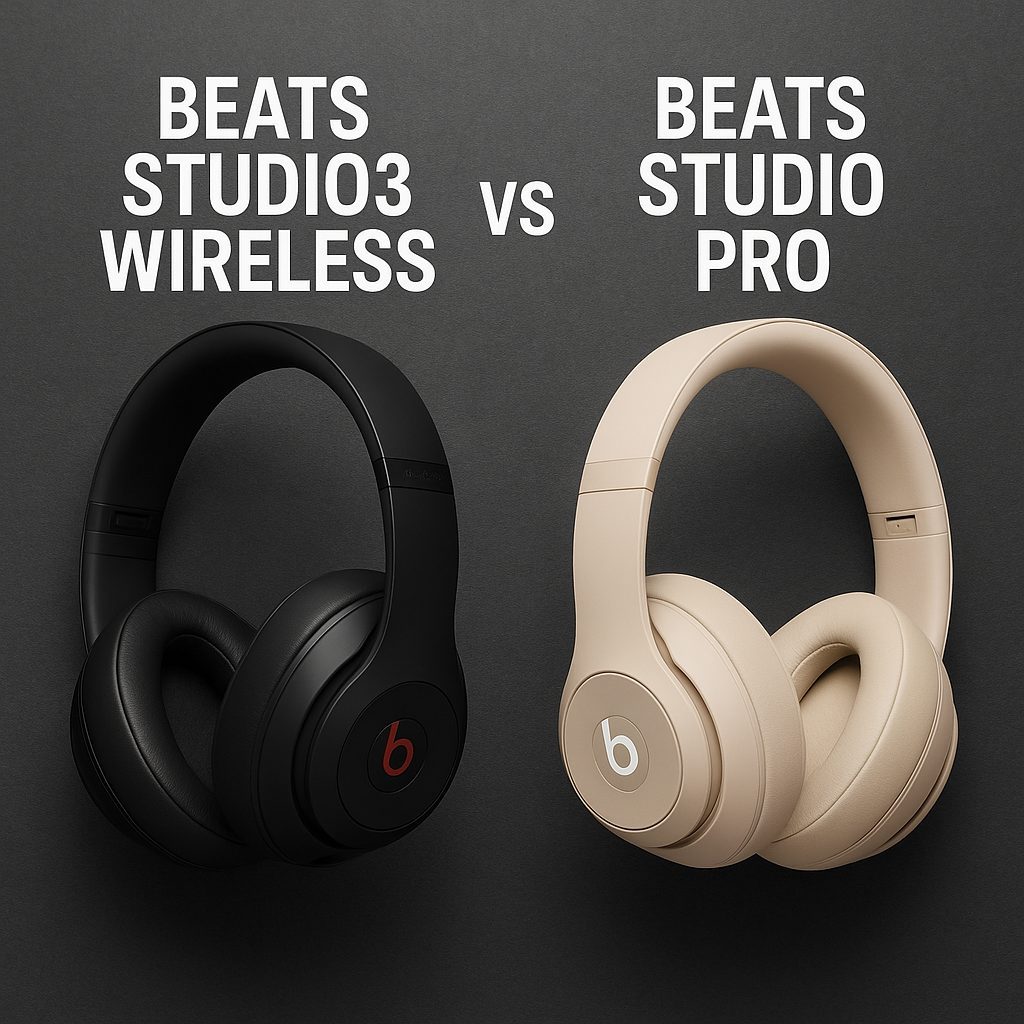
Both models are over-ear, closed-back headphones. They fold inward for travel convenience and use metal sliders for adjustable fit.
-
Both are light enough for long listening sessions — the differences in weight are minimal. One review measured a 6.8 g difference between them.
What changed in Studio Pro
-
The Studio Pro uses slightly updated ear cushions (UltraPlush design) that many find more comfortable for long hours of wear.
-
The build feels more refined: while still sleek and minimalistic, the Studio Pro drops some of the older branding styling for a more modern finish.
Verdict on comfort: For everyday listening or long sessions (work, study, travel), the Studio Pro has a modest but noticeable edge — though the Studio 3 is by no means uncomfortable.
Connectivity & Features
Wireless, Wired & Chip Support
-
Studio 3 Wireless uses the older Bluetooth version and is powered by Apple’s W1 chip — which made it popular among iPhone and Apple-device users.
-
Studio Pro upgrades with newer connectivity tech: USB-C charging/connection, updated proprietary Beats chip that works smoothly with both iOS and Android, and allows modern features like one-touch pairing, device switching (on supported platforms), “Find My” on Apple devices, and more.
Audio Quality & Formats
-
The Studio Pro supports high-fidelity wired audio over USB-C. That means, with compatible source devices and tracks, you get lossless (or near-lossless) audio — a major step up for audiophiles.
-
Studio 3 lacks these modern wired audio enhancements; it was built for wireless convenience more than audiophile-level fidelity.
Noise Cancelling & Ambient Awareness
-
Both headphones offer Active Noise Cancelling (ANC), but Studio Pro’s ANC is significantly more powerful — especially at blocking lower-frequency background noise.
-
Crucially, Studio Pro introduces Transparency Mode (sometimes called “Ambient Mode”), which Studio 3 lacks. This lets you hear ambient sound when needed — useful when walking around, commuting, or talking to someone without removing headphones.
Verdict on features: If you care about modern features — better connectivity, wired hi-fi, adaptive noise cancelling, and ambient awareness — Studio Pro is order-of-magnitude ahead.
Sound Quality & Audio Performance
Signature Style vs Balanced Audio
-
Studio 3 was known for a more bass-heavy sound profile — strong lows, but it often lacked clarity in midrange and upper frequencies. Many listeners found it “boomier” and less refined.
-
Studio Pro moves toward a more balanced and accurate tuning. Mids and highs come out clearer, overall dynamics are improved, bass is more controlled, and detail retrieval (in vocals and instruments) is better.
Clarity, Detail & Immersiveness
-
With Studio Pro, the improved drivers and audio processing result in less distortion at high volume, better separation between instruments/vocals, and generally a more engaging listening experience.
-
The addition of features like virtual surround / spatial audio (on supported devices) and the possibility of lossless wired listening make Studio Pro more future-proof — ideal for movies, games, and high-quality music listening.
Verdict on sound: Studio Pro is a major upgrade — richer, clearer, deeper. The Studio 3 still sounds good for casual listening, but it doesn’t compete in audio refinement.
Battery Life & Charging
-
Both headphones offer up to 40 hours of playtime (ANC off).
-
With noise cancelling engaged: Studio 3 offers about 22 hours, while Studio Pro slightly improves that to 24 hours.
-
Studio Pro also supports fast charging: a short 10-minute top-up gives several hours of playback.
For most users, battery life will be ample — but Studio Pro offers a subtle advantage when ANC is on, or when you forget to charge and need a quick boost.
Practical Use: Which Headphones Fit What Situation
Here’s a breakdown of who might prefer which model:
Choose Studio Pro if:
-
You want modern features: USB-C, lossless audio, spatial audio, adaptive ANC, transparency mode.
-
You care about audio detail and balanced, clean sound.
-
You travel, commute, or work in noisy places and want strong noise isolation.
-
You use multiple devices (Android, iPhone, laptop) and value flexible connectivity.
Choose Studio 3 Wireless if:
-
You want a simpler, proven, more budget-friendly pair.
-
You mostly use headphones for casual listening, podcasts, calls.
-
You prefer the “classic Beats” sound signature with stronger bass emphasis.
-
You’re okay trading modern features for lower cost (or better sale deals).
For many casual listeners — especially those who mainly listen on the go, commute, or want a dependable pair — Studio 3 remains a solid choice. But if you’re after longevity, performance, and overall quality, Studio Pro is clearly the more future-ready bet.
At-a-Glance Spec Comparison
| Feature / Spec | Beats Studio 3 Wireless | Beats Studio Pro |
|---|---|---|
| Release Year | 2017 | 2023 |
| Noise Cancelling | ANC (Pure/Adaptive) | Improved ANC + Transparency Mode |
| Connectivity | Bluetooth + W1 chip (mainly for Apple devices) | Bluetooth (newer), USB-C wired audio, cross-platform support |
| Audio Format | Wireless stereo (no high-fidelity wired audio) | Supports high-fidelity wired audio via USB-C, plus better overall tuning |
| Comfort / Build | Good, foldable, adjustable metal sliders | Slightly improved cushions (UltraPlush), refined build |
| Battery Life (ANC off) | ~40 hours | ~40 hours |
| Battery Life (ANC on) | ~22 hours | ~24 hours |
| Special Features | None beyond ANC + wireless convenience | Transparency Mode, USB-C wired audio, better ANC, cross-platform support, possibly spatial audio / surround support on compatible devices |
| Ideal For | Casual listeners, Apple device users, budget-minded buyers | Music lovers, travelers, commuters, cross-platform device users, those seeking best overall sound and modern features |
Conclusion: The Clear Winner — But It’s About Your Needs
When you line up the specs, features, and real-world experience side by side, the Studio Pro emerges as the clear upgrade. Its improved sound quality, modern connectivity, stronger noise cancelling, and boosted comfort make it an excellent companion — whether you stream high-fidelity music, travel often, or work in noisy environments.
That said, Studio 3 Wireless remains a compelling option if your priorities are simplicity, familiar sound signature, and value for money. For casual listeners who don’t need USB-C audio or advanced ANC, it can still deliver enjoyable music sessions with less investment.
In short: if you want future-ready headphones that deliver refined audio and flexibility — go for Studio Pro. If you want steady, dependable performance for everyday listening at a lower cost — Studio 3 Wireless still stands its ground.
FAQs About Beats Studio 3 Wireless vs Beats Studio Pro
What is the main difference between Studio 3 Wireless and Studio Pro?
The main difference is that Studio Pro is a modern upgrade: it brings better sound quality, improved noise cancelling, USB-C wired audio support, and newer connectivity compatibility. Studio 3 Wireless is older, with simpler features and a bass-heavy sound signature.
Is the noise cancelling much better on Studio Pro than Studio 3 Wireless?
Yes. Studio Pro’s ANC is noticeably more effective — especially at reducing low-frequency background noise. Also, Studio Pro offers a Transparency Mode to let in ambient sounds when needed, a feature completely missing from Studio 3 Wireless.
Can I get higher sound quality with Studio Pro?
Absolutely. Studio Pro supports high-fidelity audio over USB-C (lossless/near-lossless), and its tuning is more balanced across bass, mids, and highs. The sound is clearer, more detailed, and overall more engaging than Studio 3’s more bass-centric profile.
How is battery life different between the two models?
Both headphones give up to around 40 hours playback with noise cancelling off. With ANC on, Studio 3 delivers about 22 hours, while Studio Pro improves slightly to about 24 hours. Studio Pro also offers faster charging — a short 10-minute charge gives extra hours of playtime.
If I mostly use headphones casually (music, calls), is Studio 3 still worth buying?
Yes. For casual listening, podcasts, calls or occasional music — Studio 3 Wireless remains a decent and more budget-friendly choice. If you don’t need modern features like USB-C audio or advanced noise cancelling, you’ll get good value and reliable performance for daily use.